Cosmic Monsters Doing the Unthinkable
For decades, astrophysics taught us one universal truth about black holes: they are cosmic one-way streets. Anything that crosses the event horizon—the boundary where gravity becomes so intense that not even light can escape—is trapped forever. When two black holes collide, they fuse into an even bigger giant. But what if a black hole could actually rip apart?
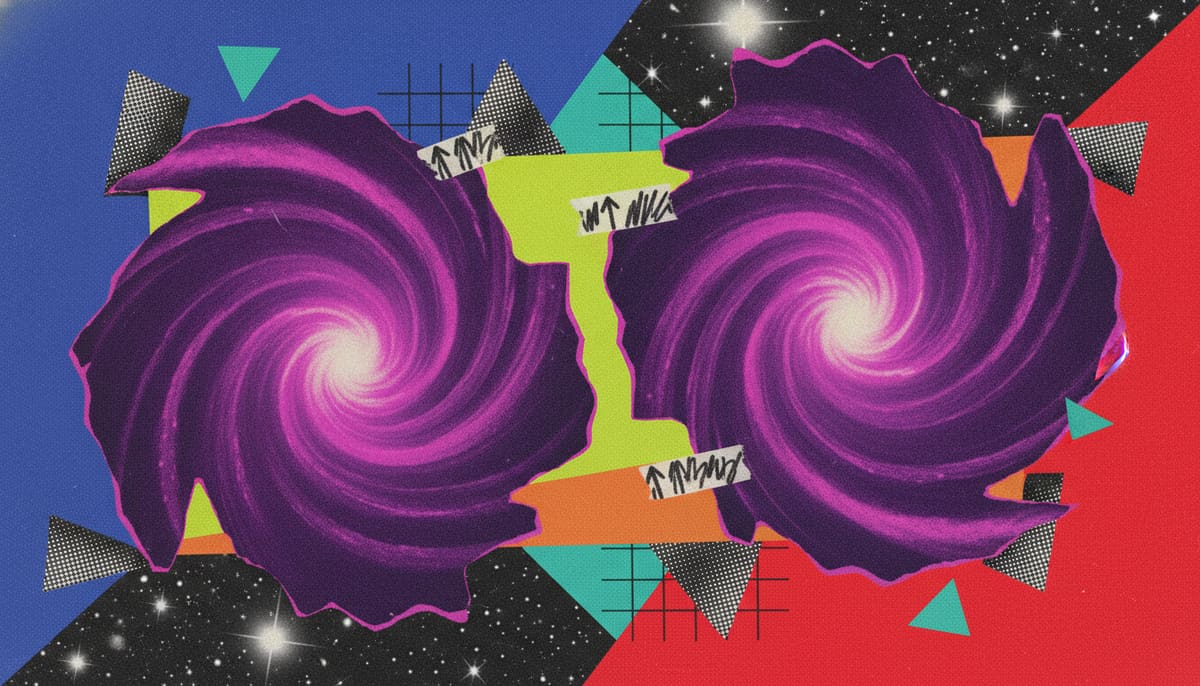
Fresh computer simulations from theoretical physicists suggest that under wildly extreme conditions, a single black hole can tear itself into two separate pieces. The secret ingredient isn't an outside weapon or an explosion, but sheer rotational speed.
Breaking the Cosmic Speed Limit
When matter collapses to form a black hole, it usually spins, much like water swirling down an open drain. According to physics calculations, as a spinning black hole accelerates toward the universal speed limit, strange things happen to its shape:
- Its event horizon bulges violently outward along its equator.
- The central gravitational pull stretches dangerously thin near the core.
- If the centrifugal force overcomes gravitational tension, the hole pinches at the waist and splits.
Scientists call this theoretical threshold an extremal black hole, a point where rotation rivals gravity itself. If confirmed by future space observatories, this discovery could completely rewrite how astronomers understand the life cycle of galaxies.
Would you dare travel near a spinning black hole if you had a warp-drive spaceship?
Source: Space.com