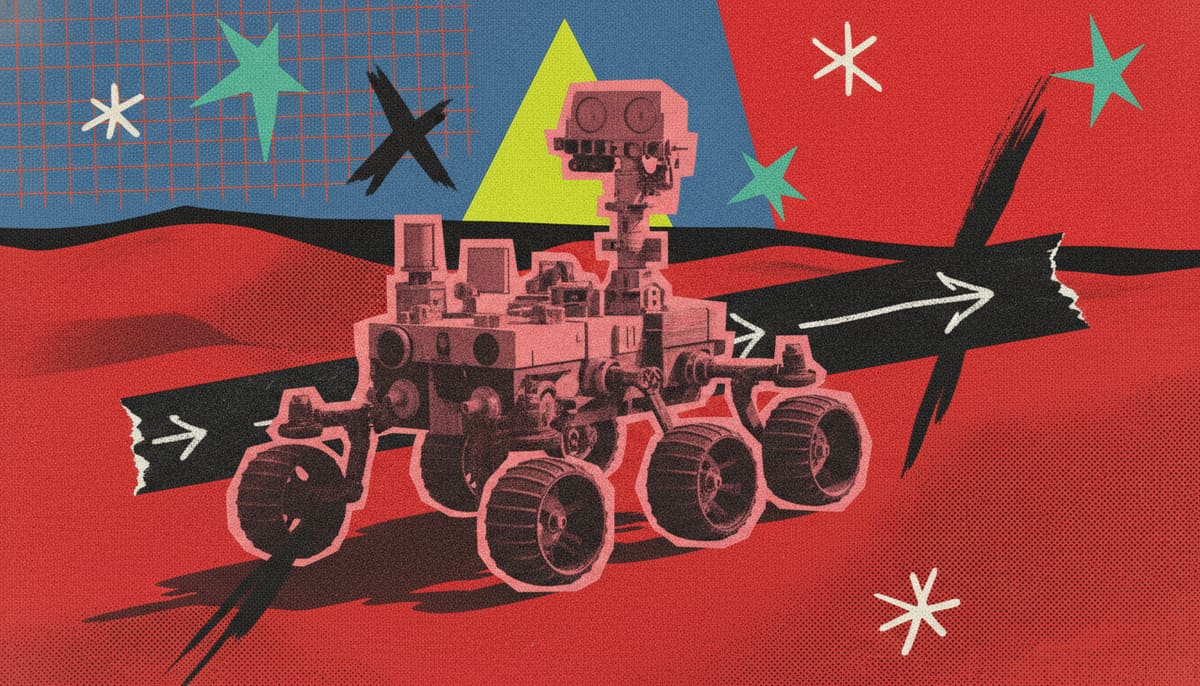
Rolling Into the History Books
Driving on Earth can be tough, but imagine navigating giant boulders, loose sand, and steep craters millions of miles away with no mechanic in sight. That is exactly what NASA’s Perseverance rover tackles every single day on Mars. Now, the six-wheeled robotic explorer has officially rolled into the record books by completing the longest drive ever made on another celestial body—a fancy scientific term for a planet or moon.
On October 11, the rover's odometer passed an astonishing 45.22 kilometers (about 28.10 miles). An odometer is the instrument that tracks total distance traveled. This incredible trek through Jezero Crater pushed Percy past previous interplanetary road-trip champions, proving just how tough modern planetary robots really are.
How a Robot Drives on Mars
Driving on the Red Planet is not like steering a remote-control car in your backyard. Because radio signals take up to twenty minutes to travel between Earth and Mars, human engineers at the Jet Propulsion Laboratory cannot drive with a live joystick. Instead, they give Perseverance advanced navigation software called AutoNav.
- Smart vision: Percy uses stereo cameras to map out 3D terrain and spot hazards like sharp rocks.
- Autonomous thinking: The onboard computers calculate safe pathways completely on their own while moving.
- Durable wheels: Specially ribbed aluminum wheels grip Martian bedrock without getting stuck.
Perseverance is currently climbing the steep rim of Jezero Crater to hunt for clues about whether ancient Mars ever hosted tiny microbial life. Every kilometer adds valuable data about alien geology and tests technology that future astronauts will rely on when they finally walk on the red dirt.
If you could send a robotic rover to explore anywhere in our solar system, where would you steer it first?
Source: NASA